Saturday, February 16, 2013

A Picture Is Worth a Thousand Memories

I created a close-analysis assignment for my film students and decided to do the assignment myself so that they would have a sample. I think it turned out pretty well, so I'm posting it. The assignment asks students to take a one- or two-minute scene; describe the background information needed to understand the scene; use a snipping tool to capture every shot in the scene; describe each shot, angle, transition, and duration of the shot; and write a 1-2 page analysis of the scene, discussing how the cinematography, mise-en-scene and editing impact the meaning. I chose Christopher Nolan's Memento (2000), based on a short story by his brother Jonathan. You'll notice that I don't have images for the shots. For some reason I couldn't copy and paste the images from the film from my Word doc.

Set up/Background Information:

Memento tells the story of a man named Leonard who suffers from short-term memory loss. Leonard believes his wife has been raped and murdered, and he, as a self-appointed vigilante, spends his days and nights tracking down the murderer. Because of his condition—his inability to remember incidents after the murder for more than a few moments—he writes basic information like “my car” on Polaroids, tattoos “facts” all over his body, and leaves post-it notes for himself everywhere. This is the first scene in the film, and it is shot in reverse. What follows the short opening scene is the first of many black-and-white scenes scattered throughout the film that occur in chronological order. These scenes are juxtaposed with the color scenes edited in reverse chronological order. The color and black and white eventually merge towards the end. Thus, the film ends at the chronological beginning of the story.

Summary of Scene:

 In this scene Leonard shoots and kills a man at point blank. He then takes  a Polaroid of the dead man. But because the scene goes in reverse, we first see the completed Polaroid picture, which then disappears.  The picture re-enters the camera, the gun flies from the ground and into Leonard’s hand, the man screams, the shell bounces upward into the gun, the bullet enters the gun.

 Analysis of Scene:
Intentionally jarring and confusing on its first viewing, this scene presents a microcosm of the ideas in the film as a whole. The Polaroid picture’s disappearance and the bullet’s re-entering the gun both serve as metaphors for Leonard’s condition. For him, memories are as ephemeral as the gratification of vengeance he receives in killing whom he believes to be his wife’s rapists and murderer. That is, memories and gratification disappear just like the picture. Because the scene is shot in reverse, for Leonard it is as if this murder never occurs—the bullet was never shot and the picture never taken.  Even though he takes a picture of the dead man, we know from other events later in the film that he will likely destroy this picture so that he can continue to hunt down and kill whomever he believes to be the true murderer. The picture will disappear when Leonard burns it. In doing so, Leonard sadistically exploits his condition to enjoy the pleasure of the pursuit and the fleeting moment of doing what he has convinced himself is right. He has supposedly avenged his wife.

One of the interesting features of the scene is Nolan’s use of close-ups and extreme close-ups. Only three of the 16 shots are not close-ups, but even these three are medium close-ups. With the lack of establishing shots or a traditional master shot, we don’t know where we are; we don’t see long shots of both of the men in the same frame; we don’t know why Leonard is murdering this man; we don’t even know who Leonard is at this point. Close-ups are traditionally used sparingly for emotional impact or to enhance a particular performance. But Nolan emphasizes and uses the close-ups to place the viewer in Leonard’s incredibly limited point of view.  We see what Leonard sees, and Nolan wants the audience as confused as his character. The scene epitomizes subjectivity.

What the close-ups show, however, might be even more significant that the use of the close-up. We see blood running on the floor, bloodied eye glasses, a shell casing, and the back of a man’s head.We only see the murdered man’s face for just a moment, a fraction of a second as he turns away to avoid the bullet. Thus, Teddy is not really a man. He is a collection of disembodied body parts and objects. He is an object himself, an object whose sole purpose is to fulfill some kind of fantasy in Leonard. A fantasy that Leonard knows is not the truth. The objectification of Teddy makes it easier for Leonard to kill him, and, shockingly, easier for the audience to approve of the murder. We are made participants in the heinous act.

Not only does Nolan employ primarily close-ups but he also edits them in rapid progression to further emphasize the ephemeral nature of the scene itself. After the initial six- then eleven-second shots, the rest of the shots last only one or two seconds. And the final shot last less than one second. The fact that the photograph shots last longer than the actual murder proves significant. By shortening the murder scene to mere moments of time and a few scattered shots, Nolan ironically downplays the seriousness of the murder. The viewer watches Leonard’s hand for a longer amount of time than we see the dead body, just as Leonard would. Also, if we were to blink we would miss the murder scene. It comes and goes just like Leonard’s memories. Murder is forgotten. It is not a big deal.

One important feature of the mise-en-scène is the color palette, color which is echoed throughout and serves as a metaphor for Leonard’s condition and the subjectivity of human nature.  Leonard’s tan suit compliments the brownish grey of the floor and walls. These earth tones might evoke the metaphorical grey area that Leonard has entered, an ambiguous place where in the moment he feels what he is doing is right only because he has lied to himself to get there. Possibly the grey might represent grey matter in Leonard’s diseased brain. The browns and greys contrast with the prevalent blues: from the bright blue title letters to the dark blue of the dead man’s denim jacket to the blue of Leonard’s shirt to the blue of Leonard’s eyes. Blue is the color of the sky and the ocean; it represents vastness and power. Leonard holds the gun, pulls the trigger, and has the power to take away life, whether that life deserves to be taken away or not. He is a god among men.

The use of fade-from- and to-black at the beginning and end of the scene parallels the image of the blank, undeveloped picture at the end of the first shot. With these transitions Nolan reinforces the idea that Leonard’s memories are wiped away—they also fade to black—just as the picture is wiped away. But beyond Leonard’s specific condition, Nolan implies here and throughout that that memories and, indeed, reality are subjective for all human beings, not just those with short-term memory loss. We, too, can never really know the truth, and we justify our routines and habits because they are truth to us.

With the use of close-ups, rapid editing, reverse filming, and an emphasis on the colors blue and grey, Christopher Nolan has set up the major themes and philosophy of the film as a whole. While these film elements specifically comment on the unreliability of memories, Nolan is after something much deeper and profound. The film becomes a kind of thought experiment that not only questions the reliability of truth but questions reality as a whole. It asks the ultimate question: In a world where memories and reality are as ephemeral as a few seconds of film, how can we truly know anything? We may be able to convince ourselves that we think we are right about our religion, our life philosophy, and our morality. But how do we really know?


Sunday, January 20, 2013

The Kid and the Virgin Mary


With The Kid with a Bike, Belgian brothers Jean-Pierre and Luc Dardenne directed one of the most critically acclaimed films last year and won the Grand Prix at Cannes in 2011. Film Comment ranked The Kid with a Bike number seven on their Best Films of 2012 list, and it has appeared on several other top-ten lists. The film tells the story of an 11-year-old boy named Cyril, whose father not only abandoned him to a boy's home but also sold Cyril's sole meaningful possession: his bicycle. Refusing to believe his father would do such a thing, Cyril, played with intense authority by newcomer Thomas Doret, begins a journey to find his father and disprove what he knows could not possibly be true. If the story sounds at all like the classic Italian neorealism film Bicycle Thief, it may have echoes but they aren't really similar. The father is noticeably absent in this story, and while the Italian film was primarily a commentary on the bleak post-war economic reality for men and the moral ambiguities that reality leaves them facing, this film is ultimately quite hopefull.


Stubborn, tough, restless, aggressive, and desperately in need of love, Cyril is a character who frustrates us but also garners our sympathy. He's clearly a product of his terrible circumstances. I couldn't help wanting to shout what would of course have been terribly painful for him or any child to hear: "your father does not love you." While attempting to escape from authorities, Cyril literally runs into a local hairdresser, knocking her off a chair in the waiting room to a medical center and subsequently holding onto her with all of his strength. As the men pull Cyril off of her, she says, "You can hold me if you want...but not so tight." The Dardennes acknowledged in an interview in the March/April issue of Film Comment that the mother and child image was meant to be a reverse pieta, an artistic representation of the Virgin Mary cradling the dead Jesus in her arms. While he may be holding her in this particular moment, the Virgin figure will do the carrying later in the film.

Michelangelo's Pieta (1498-99)

The Mary figure is goodness and purity to her core. She agrees to take Cyril in on the weekends, she drives him to see his father, she provides a safe, loving home for him and never expects anything in return. More importantly, she puts up with his poor manners, his aggressiveness, his disobedience, and his inability to return her love. She is a lovely human being, and we can't help but wonder why she doesn't give up. It's not as if she owes him anything. Of course, we know and the Dardennes know that there are people like her in the world. Some of us aspire to be like them but most of us fall short.

I tend to be drawn to darker stories: crime dramas, post-apocalyptic zombie tales, classic- and neo- films noir, and bleak endings.  And there are plenty of these types of stories today. Bleak stories are so prevalent that I wonder if the phrase "Hollywood ending" is anachronistic. Anyway, it's refreshing to see a film so rife with Christian symbols and messages--when it's presented in the Dardenne's characteristic neorealism, subtlety (no heavy-handed symbols here), and anti-melodrama (at least to a degree). But The Kid with a Bike uses Christian symbolism not so much to endorse or promote Christianity--or any religion for that matter--but to comment on the possibility of hope, love, redemption, and forgiveness in an increasingly secular world. The Dardennes were raised Roman Catholics but their films probably owe more to French filmmaker Robert Bresson (also raised Catholic but he famously called himself a "Christian atheist"--whatever that means) than to Catholicism. The Kid with a Bike has its descent into hell (or maybe hells plural--I suppose there a few of them for Cyril), its ascent from that world into the light of goodness and truth, a world where a kid can ride his bike with his mother. The sun shines and we know that the world isn't always a good place, but sometimes it can be.

Sunday, January 6, 2013

Happy, Selfish Souls: The Loneliest Planet

After watching Julia Loktev's fascinating, subtly philosophical and psychologically complex  The Loneliest Planet, I read several reviews to see what other people had to say about it. Of the six or seven reviews in The New Yorker, The Boston Globe, Entertainment Weekly, and others, everyone focused on a key moment that takes place about midway through the film. While this moment is admittedly unsettling and presents a turning point in the relationship between the engaged couple, I thought there were three additional moments that, though perhaps not as shocking as the first, were equally interesting and equally troubling.


The film tells the story of Alex and Nica, played by Gael Garcia Bernal and the Israeli actress Hani Furstenberg, and their backpacking trek through the Caucasas Mountains in Georgia. Alex and Nica, engaged to be married in a few months, seem quite happy together. Opening with a nude Nica jumping up and down to signal her doting Alex that she needs help washing her hair, the film reveals many small scenes that typify their loving and happy relationship. They playfully swing on bars inside a bus, dance together and apart in a local Georgian bar, stand on their heads counting "one chimpanzee...two chimpanzees...three chimpanzees," practice Spanish verb conjugations, and politely listen without judgment to the often crude or slightly bigoted stories of their local guide. All while nearly constantly smiling or laughing. This seemingly perfect couple love each other and seem destined for nothing but happiness in life.


All of this becomes much more complicated after the aforementioned moment. (SPOILER ALERT: Don't read on if you think you might watch the film. Please see the film and experience it for yourself.) As Alex and Nica are walking with their guide, they encounter what might be a father and his two sons. The father(?), a man perhaps in his 60s carries an assault rifle. (A couple of the reviews thought the men were guerrilla soldiers, but the boys seem too young to me and they weren't armed, so I'm not really sure who they were supposed to be.) The three appear to know the guide and speak to him in Georgian, but we don't get subtitles, so we don't know what they are saying.  The conversation quickly become tense and there are raised voices; they seem to be upset about Alex and Nica. Alex asks what's going on and the armed man suddenly turns on him, pointing the rifle at Alex's head. This is the shocking moment: Alex quickly grabs Nica and uses her as a shield by putting her between him and the rifle. It's a skillfully staged moment, and it's clear that it is not a calculated move by Alex. It's an unconscious instinct; he does this without thinking about it. He does it to protect himself. After this incident, Nica is understandably upset. Her almost constant smile turns to an almost constant scowl. She doesn't want to speak with Alex and doesn't want to be touched by him. What is interesting about this situation is that, while it was certainly a cowardly and selfish act, it was not done maliciously. He did it without thinking. But the question is, does that matter? Whether is was instinctual or not, he still did this horrible and selfish thing, and we wonder if the relationship can last after this, despite how happy they seemed at the beginning of the film.

The theme of the power of instinct and the question of how much control we have over our actions is reinforced by the mise-en-scene and cinematography. While the film is mostly shot outdoors and we are nearly overwhelmed by the green, verdant, unspoiled grass and mountains, Loktev frames all of the shots in such a way as to never show us a true horizon line. Sometimes I thought I was seeing a horizon line but it was really just a snow-covered mountain in the background. Thus, the greenery and mountains close the characters in an imprisoning, inescapable world. This is done subtly, but it's a perfect example of how cinematography can add to the meaning of a film.

Another key moment occurs when Nica crosses a shallow stream and falls in. Loktev again films and edits the scene brilliantly. The camera is pointed at Alex's back, following him after his safe crossing, and we only hear the splash and cry off screen. Partly because of the guide's position (you'll have to watch this for yourself to judge), the guide rushes in to help her. Alex enters the water, too, but is too late to help and is told to rescue her backpack instead. The guide carries Nica safely to dry land and Alex takes her from him. She immediately jumps out of her fiance's arms. Once again, Nica is visibly upset but we aren't sure if she is upset at Alex for not helping her (maybe she fell in on purpose to test him), or if she is still angry over the earlier shield incident, or if she is angry at herself for falling.

The two other key scenes occur toward the end. Alex retires to his tent early while the guide and Nica remain by the fire drinking out of a ram's horn and exchanging stories of love and loss. The guide asks Nica if he can kiss her and she laughs and then says he can on her hand or check. The guide moves to kiss her on the check but kisses her on the lips instead. He kisses her long and deep and passionately while he caresses her body and she not only allows it but seems to be enjoying it--at least in the moment. Nica returns to her tent, cuddles with Alex and they begin to have sex, but suddenly she gets nauseous and rushes out of the tent and vomits. Alex caresses her bright red hair in a scene that mirrors the hair washing scene from the beginning.

So, here are the questions: Is Nica's kissing the guide justified? Is it an act of revenge? Is it as bad as Alex's selfish act? And what is to be made of her nausea? Is it guilt? Or does the thought of relations with Alex now sicken her? And the biggest questions remain unanswered. Will their relationship survive this trek through the loneliest planet? We see at the end that this couple is clearly more flawed than we initially thought. They are not destined for the happiness that we had hoped for them. Maybe they will separate. Maybe they will remain together and regret it. Or maybe they will be able to forget and forgive each other. My take on the film is that all of these moments, while revealing the flaws of these sympathetic characters, really tell us that they are simply human. They do selfish things that they might not really be able to control, but these acts are representative of who we are as human beings. We fail in so many ways. But if we can't move past our failures, we, too, will live in what can only be the loneliest planet.


Thursday, October 18, 2012

The Great Emancipator


Taking place in the months after the Gettysburg address, Steven Spielberg's latest film Lincoln, starring Daniel Day-Lewis and based on the Dorris Kearns Goodwin book Team of Rivals, tells the fascinating story of the passage of the 13th Amendment, the amendment that would abolish slavery. There aren't many great historical political dramas in the history of film. The Battle of Algiers and All the President's Men are, I suppose, the two classics, but if we break the genre into historical political films about the passage of a law, those are certainly rare. Lincoln is not only a great historical political drama, it's a near masterpiece and one of Spielberg's best accomplishments. Period. I just saw a free advanced screening, so for once, I'll say a few things about it before most others have seen it--I might even have seen it before most film critics. Cool.


First,  Day-Lewis will win the Academy Award. I can almost guarantee it--or, I would be shocked if he didn't. I can't imagine a better performance. It's a remarkably subtle characterization, especially considering his ridiculously over-the-top, overly theatrical performances in both Gangs of New York and There Will be Blood--both of which were a bit too much for me. In Lincoln, he plays a soft-spoken, pensive, psychologically complex, almost frail and seemingly vulnerable Lincoln. A kind but tormented president, Lincoln is troubled with the blood spilled and great sacrifices given daily on the battlefields of the Civil War, troubled by the fact that he recently lost his young son, troubled that he, as president, cannot grieve for him, and troubled that his eldest son wants more than anything to join the Union cause and fight. Lincoln is witty, warm, forgiving, and angry when he needs to be. He is a great listener, a man famous for placing former rivals in his cabinet, and a great storyteller. He always knows just the right story to tell in just the right moment. In one scene, his secretary of war storms off during a particularly tense moment, yelling that he can't take another God-damn story. But everyone else seems eager to listen.

And all of this praise is coming from someone who doesn't think very highly of Spielberg. In fact, Spielberg is one of the most overrated directors. His films are fun, popcorn fair, made for a mostly mindless mass audience. He almost always overdoes the musical score and cranks up the sentimentality with close-ups and lighting. I like Jaws well enough, and I'll always be a bit nostalgic for the Indiana Jones films, and first two Jurassic Park films were pretty fun, but I think Schindler's List is overrated. Rarely do we see Spielberg grappling with interesting ideas. He's usually only concerned with plot and character. This is why Lincoln surprised me. It was deliberate and stately, almost European in its pacing. There were a couple of cheesy Spielberg moments--one occurs right at the beginning where several soldiers start quoting the Gettysburg Address and the John Williams score plays in the background to make sure we know this is the moment we are supposed to be moved to tears. But mostly he tones down the sentimental music--at least compared to his other films. The fact that he has directed a moving and gripping drama about the passage of an amendment is saying something.

I wasn't a big fan of Tommy Lee Jones. He just sounds too much like Tommy Lee Jones and didn't disappear into his role. I couldn't get the person out of my head, whereas with Day-Lewis and Sally Field I could. But this is a fairly minor quibble.


What struck me from nearly the first moment was the relevance of the story. It was very difficult to get people from Lincoln's own party to support the amendment--and vastly more difficult to get the overtly racist Democrats to sign on. I couldn't help think about how difficult it was for President Obama to get the healthcare law passed. It's true that there wasn't bipartisan support, but there wasn't bipartisan support for the abolition of slavery either. The handful of Democrats who voted in its favor only did so because they were lame ducks and were promised lucrative political positions afterword. And it was a much more moderate amendment than the radical Republican wing wanted. Stevens and others wanted not just to free slaves but to give blacks the right to vote.

It was a monumental task, and Lincoln had to lie and cheat a little to get it done. Maybe honesty is a bit overrated.

Thursday, October 4, 2012

The Poetry of Woody Allen


I watched Woody Allen's latest film, To Rome with Love, a few weeks ago, and I was nothing but disappointed. Alec Baldwin should make any film watchable, but his role was so strange it bothered me throughout. He was both a character in the story and some sort of omnipresent life force who would appear out of nowhere to give one of the other characters advice about love and life. I guess Allen was attempting to resuscitate the Bogart character in Play It Again Sam (1972)--in both films only the male character can see the Baldwin/Bogart character; he's invisible to the women. On the whole, I've been pleased with most of Allen's recent films: Match Point (2005) and Vicky Cristina Barcelona (2008) were masterpieces and Midnight in Paris (2011) was great--maybe not a masterpiece but very good. On second thought, despite my mad love for Larry David and Curb Your Enthusiasm, Whatever Works (2009) was pretty terrible and You Will Meet a Tall Dark Stranger (2010) no better. Allen's problem is that he is so prolific that he doesn't seem to want to slow down to refine his work. It's either hit or miss for him.


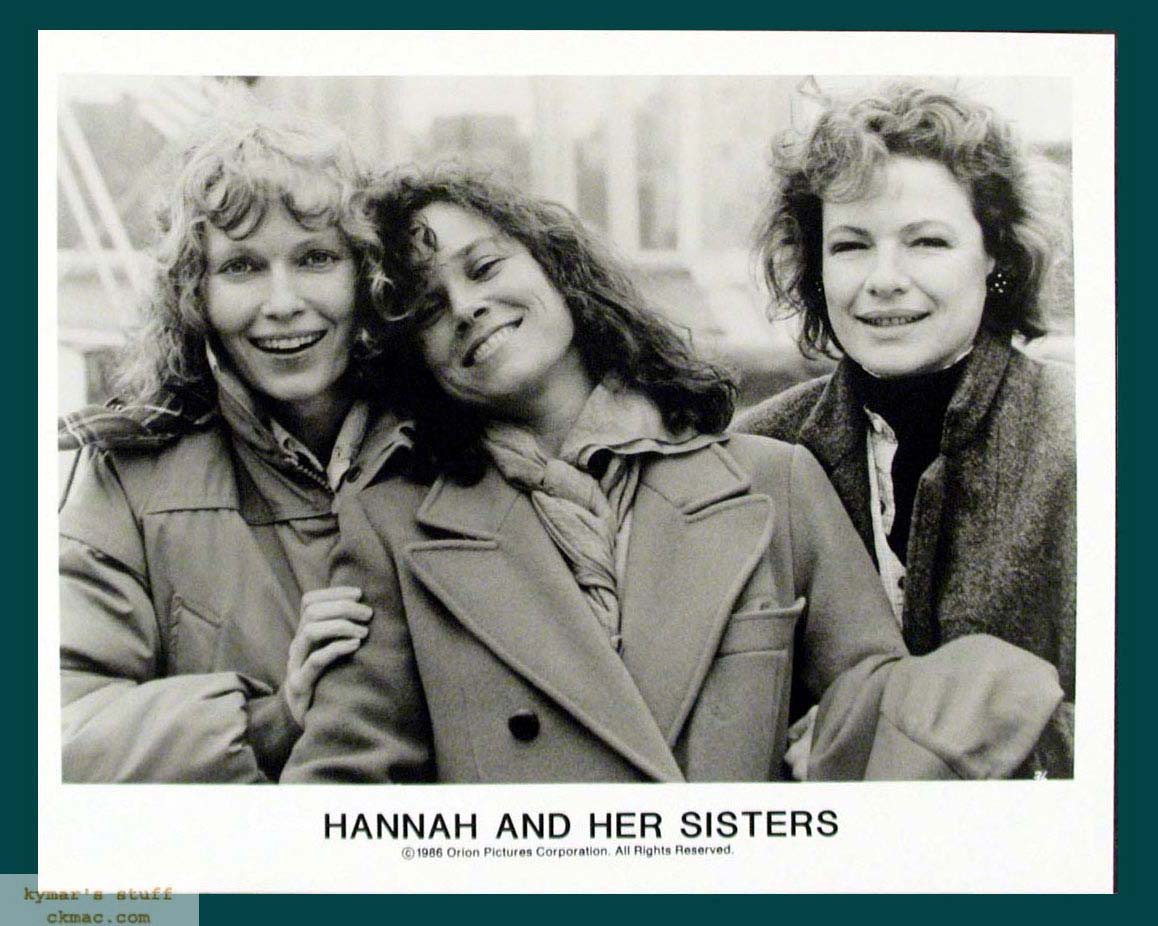
After watching Rome, I decided to revisit some classic Allen films, including Annie Hall (1977), Manhattan (1979), A Midsummer Night's Sex Comedy (1982) and Husbands and Wives (1992). I guess I was second-guessing how highly esteemed Allen is. I mean, how is it possible that the same person who wrote and directed Celebrity (1998) also did Hannah and Her Sisters (1986)? But after re-watching those classics, my doubt was alleviated and I was fawning over Allen once again. While I still absolutely love Annie Hall and Manhattan, I was especially taken by Hannah and Her Sisters. It's a moving and dramatic film about love, adultery, loss, and death.  But its power lies in its balance between drama, philosophical profundity, and humor. It's true that the main story follows Hannah, her husband, and the affair her husband has with one of Hannah's sisters.


But the subplot with Allen's character makes the film beautifully poetic. Allen plays Hannah's ex-husband, a television producer and severe hypochondriac. While he is with the doctor for a routine phisical, the doctor finds something he wants to check out. It might be cancer. The possibility of this throws Allen into a tailspin of paranoia and existential dread while he waits for the test results. He visits the doctor again, finds out that he does not have cancer, and leaves the doctor's office literally jumping and skipping for joy. But suddenly he stops. And in that moment, that perfectly paced and edited moment, he realizes that while he is not going to die of cancer, he will die eventually, and this fact fills him with more dread. He then spends time turning to religion, testing out different denominations other than the Judaism he was brought up with: Catholicism and Hari Krishna. Not surprisingly, these options don't work out for him but add lots of classic Allen moments. Ultimately, he learns the great lesson about life--that life is a struggle, that death is inevitable, but that we can all find some measure of happiness despite these ineluctabilities.

Saturday, September 15, 2012

Citizen Lame


I'm teaching a film class for the first time, and I thought I would start the class by watching Orson Welles's classic 1941 film Citizen Kane. The film appears on the top of many best-of lists. It's number one on the American Film Institute's top 100 American films, number two on Entertainment Weekly's list (just below The Godfather); and while the most recent Sight and Sound list upended CK with Hitchcock's Vertigo, if you look at any other list since 1962, CK is number one (the list comes out every 10 years). So, I thought, why not start with the best and talk a bit about why critics and filmmakers consider Welles's film the creme de la creme? My idea was that we would discuss the film before opening our textbook, before learning any technical terms. I would have students evaluate and analyze the film based on their past English-class reading knowledge. While I speculated that students may not recognize every element of the film's formal style, I thought it would be a nice foundation for us to refer back as we proceeded through the year's instruction.


But as I watched the film for probably the fifth or sixth time (though the first time with students), I quickly realized I was bored, and I didn't care much about the story or the characters. My perception of the film in this viewing may have been clouded or influenced by what I thought my students were thinking while they were watching: Are they bored? Are they paying attention? Did they notice that shot? Do they regret signing up for the class?


To their credit, my students didn't sound off any displeasure or physical or emotion pain for making them watch the film. And when we spent a couple of days discussing the film and its merits, many students offered keen insights into the film's characters, themes and visual qualities. And I should qualify my grossly hyperbolic post title by saying that even though my personal reaction was one of boredom, I still recognize the film's technical qualities. It is impressive in its visual complexity; every shot seems perfectly crafted with the lighting, props, and placement of characters clearly adding complicated meaning to every scene. The editing is equally complex, not only in its overall non-linear structure but in its variation of cuts, montages, and overlapping shots. Even the makeup is impressive, especially for a film from 1941. I've seen several current films where characters are aged and the makeup looks horribly unrealistic. Finally, the film is thematically rich; it's a film about ideas, about time, power, memory, truth, and perceptions. I like big ideas, so why couldn't I get into the story this time?


Well, it could just be this particular viewing. Maybe I'll change my mind next time.

Thursday, July 26, 2012

Richard Matheson: Idea Man

I just finished reading my third Richard Matheson story collection, and I have to say I'm hooked on this guy. Of course, he's been writing since the 1950s, so he's not exactly a recent fad. Like Kurt Vonnegut, Matheson served in the army as an infantry soldier during WWII, got married after the war, and then began writing short stories. Also like Vonnegut, Matheson dabbles in the science-fiction genre, but where Vonnegut is a satirical humorist with a distinctively simple style and primarily interested in exploring whether free will exists, Matheson's styles, tones, and themes are far more wide-ranging. Stephen King said, "I think the author who influenced me the most as a writer was Richard Matheson." And if you read just a handful of Matheson's often disturbing stories, you see why this is true. While Matheson is sometimes interested in breaking free of genre conventions, many of his works are decidedly fixed in the horror, fantasy or Western genres.


Several of his stories and novels have been adapted into television shows and films, including I Am Legend (1954), "Steel" (1956, adapted as Real Steel), The Shrinking Man (1956), A Stir of Echoes (1958), "Duel" (1971), "Button, Button" (1974, filmed as The Box), Bid Time Return (1975, Somewhere in Time), and What Dreams May Come (1978). He also wrote scripts for several Twilight Zone episodes, including the famously shocking "Nightmare at 20,000 Feet" (1963 and remade in 1983). Matheson continues to write today; one of the anthologies I read included two of his recent stories, one from 2009 and one from 2010. But he seems to have slowed down his rapid production quite a bit in the last few years.


Here's a sampling of the types of stories he writes: A woman is told she will be given $50,000 if she presses a button on a box which will result in killing someone she doesn't know, a man goes to a funeral home and makes arrangements for his not-yet-deceased wife, a man searches for the origins of dirty jokes and finds a secret society, a family prepares to live in an underground tunnel system as a result of an impending nuclear attack, a young girl shows her friend a possessed dress belonging to her deceased mother, a scientist travels back in time to witness the crucifixion of Jesus, a man discovers he has a double, large groups of people walk into the Pacific Ocean and drown for an unknown reason, a young man discovers that being a gunslinger in the Old West is far more difficult than he ever imagined.


I like Matheson because he is first and foremost a good story teller. He knows how to begin and end stories well, and many of the stories have surprising "twist" endings (often a bit like the ending in Shirley Jackson's "The Lottery"). And he is a pretty good writer of sentences. He's no Cormac McCarthy or Joseph Conrad, but he's not trying to be poetic and dense either. He writes with a natural rhythm with often surprisingly sophisticated diction that doesn't get in the way of his rapid pacing.


What I like most about his works is his emphasis, and this isn't always the case but often is, on ideas, on moral questions and unsolvable dilemmas. For instance, I Am Legend raises lots of interesting questions, some directly, some indirectly: if you were the last human on earth, would it be better to die than live alone? Is sexual desire and consummation an essential quality of the human condition? What is the worth of human life? How much effort would you put into saving your own life? Do we have control over our desire for vengeance? Similar types of questions could be asked in relation to "Button, Button": Is it morally right to will the death of an innocent person? Is there a price on innocent suffering? How well do we know our spouses and family members?

Of course, Matheson doesn't answer these questions. He is not completely ambiguous in his leanings, though. His overall vision seems pretty dark. Matheson's world is a world where innocent people suffer for no real reason. It's a world of pain, of darkness, of pure evil, where terrible monsters lurk, where people betray their families and spouses, where you can't rely on the compassion of others, where machines and mankind itself is working against you and there is nothing you can do to stop it from coming. But it is also a world of the individual, a kind of dark and realistic Ayn Randian vision (as opposed to her romantic individualism). For Matheson, the individual can will himself to survive or fight, and he can accomplish great things, but it's usually only temporary. Eventually, the individual loses. In this way, Matheson is like a Greek tragedian. His characters are caught up in a world that is out of their control, and there is no winning or escaping. But like many of the Greek characters, there is something noble in Matheson's characters attempts to do the impossible. To persevere in a world where the deck is stacked against them.